




Monday, 22 June 2026 10:30 AM
Company Update
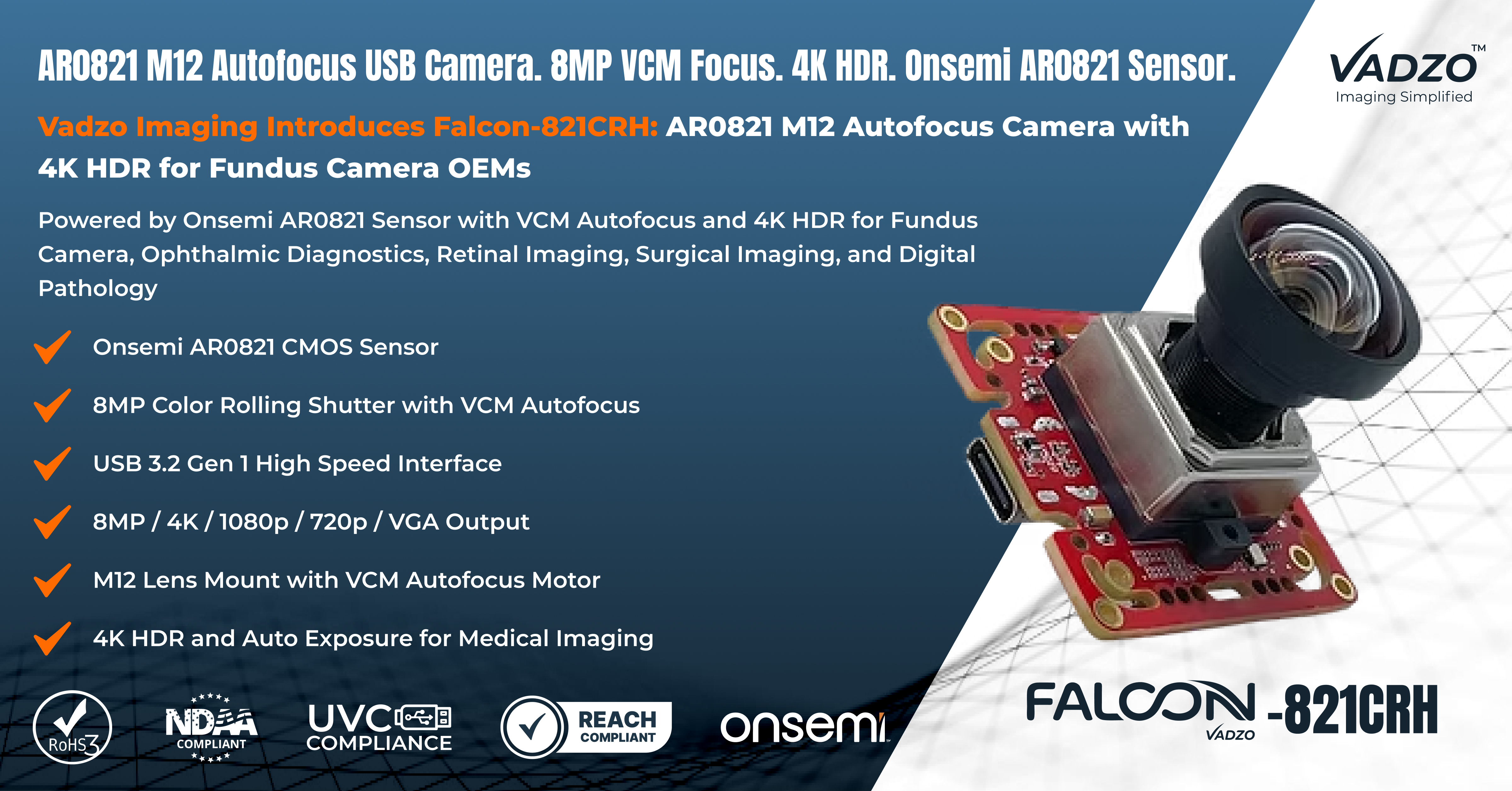
The Falcon-821CRH is an 8MP Color Rolling Shutter USB 3.2 Gen 1 Camera with VCM Autofocus, built on the Onsemi AR0821 sensor. It is designed for fundus camera OEMs, ophthalmic diagnostics instrument manufacturers, retinal imaging system integrators, surgical imaging device developers, and digital pathology scanner builders. It delivers a AR0821 M12 Autofocus Camera with 4K HDR, programmable VCM focus control, and auto exposure at full 8MP resolution with driver support for Windows, Linux, and Android in a compact M12 lens mount form factor.
FORT WORTH, TX / ACCESS Newswire / June 22, 2026 / Vadzo Imaging, a provider of embedded vision camera products, today announces the launch of the Falcon-821CRH AR0821 M12 Autofocus Camera. Built on the Onsemi AR0821 sensor and part of Vadzo's USB camera portfolio, the Falcon-821CRH delivers true 8MP color imaging with VCM autofocus, auto exposure, and HDR at full 4K resolution with support for 8MP, 4K, 1080p, 720p, and VGA output modes. With this launch, Vadzo delivers a high-performance 4K M12 Autofocus Camera that combines the AR0821 sensor's low-noise color imaging with programmable VCM focus control and intelligent HDR in a compact M12 module. This enables deployment across fundus camera OEM platforms, ophthalmic diagnostics instruments, retinal imaging systems, and surgical imaging devices with direct plug-and-play USB 3.2 Gen 1 host integration.
Sensor and Camera Overview
The Falcon-821CRH is an 8MP M12 Autofocus Camera built on the Onsemi AR0821 sensor and coupled with a high-performance ISP. The AR0821 is an 8MP (3848 x 2168) color rolling shutter CMOS sensor with a 1/1.7-inch optical format and 2.1µm pixel size. The AR0821 sensor delivers full-resolution 8MP color imaging with low noise, high sensitivity, accurate color reproduction, and advanced HDR for improved dynamic range across the variable lighting environments encountered in fundus imaging, ophthalmic diagnostics, and surgical imaging. This combination of 4K spatial resolution, VCM-driven autofocus, and multi-exposure HDR makes this AR0821 Medical USB Camera well-suited for clinical instruments requiring precise, software-controlled focus at varying working distances within ocular and biological tissue structures.
The Falcon-821CRH is a compact Medical 4K USB Camera solution. The camera module houses the Onsemi AR0821 sensor, a high-performance ISP, and a VCM autofocus lens assembly within an M12 lens holder. The VCM autofocus mechanism enables programmable, low-vibration focus adjustment across the full focal range using electrical control signals, eliminating mechanical friction and positional hysteresis that characterize manual focus assemblies. This makes the Falcon-821CRH well-suited for fundus cameras and ophthalmic screening instruments where consistent, repeatable focus positioning across patient sessions directly affects diagnostic image quality and clinical throughput. Auto exposure and HDR maintain consistent color output across the variable illumination conditions of fundus, ophthalmic, and surgical environments without manual exposure adjustment. Output modes include full 8MP, 4K, 1080p, 720p, and VGA. The camera supports Windows, Linux, and Android natively and has been validated on standard USB 3.2 Gen 1 host platforms, including medical workstations and embedded processors.
Key specs: 8MP (3848 x 2168) | Onsemi AR0821 1/1.7 inch 2.1µm pixel | Color | Rolling Shutter | VCM Autofocus | Auto Exposure and HDR | High Performance ISP | USB 3.2 Gen 1 | 8MP / 4K / 1080p / 720p / VGA | M12 Lens Mount | Windows Linux Android
Key Capabilities of the Onsemi AR0821 8MP M12 Autofocus USB 3.2 Gen 1 Camera
4K HDR Imaging for Fundus and Retinal Capture: Fundus cameras and retinal imaging systems operate in a uniquely demanding optical environment. The illuminated retinal surface presents high-brightness regions at the optic disc and fovea alongside comparatively darker areas in the peripheral fundus, creating a scene dynamic range that single-exposure imaging cannot capture cleanly without clipping the highlights or losing shadow detail in the outer retinal zones. The Onsemi AR0821 sensor addresses this through its multi-exposure HDR architecture, which compresses wide scene dynamic ranges into a single coherent 4K output frame without ghosting artifacts. This 4K HDR capability directly benefits fundus imaging camera OEMs building next-generation non-mydriatic fundus systems and retinal imaging camera instruments where image quality determines diagnostic accuracy and clinical confidence in screening programs.
VCM Autofocus for Programmable Focus Control in Ophthalmic Systems: Fixed-focus cameras cannot compensate for the variation in ocular anatomy across patient populations. Refractive error, axial length differences, corneal curvature variation, and the optical properties of ocular media mean that a fundus camera capturing a standardized retinal image must adjust focus between patients and sometimes between sequential image captures within the same examination session. Manual focus adjustment introduces operator-dependent variability and reduces clinical throughput in high-volume screening programs. The Falcon-821CRH resolves this through a VCM (Voice Coil Motor) autofocus assembly integrated into the M12 lens module. VCM actuation positions the lens element with precision across the focal range using electrical control signals, with no mechanical friction or positional hysteresis. This enables software-controlled, repeatable focus positioning for ophthalmic diagnostics camera instruments and eye screening camera systems, where consistent focus across patient sessions is a clinical requirement rather than an engineering preference.
M12 Lens Mount for Compact Medical Instrument Integration: Medical device OEMs designing fundus cameras, slit-lamp adapters, and surgical imaging modules operate under tight dimensional constraints. Instrument head diameters, parfocal distances, and optical path lengths in ophthalmic instruments leave limited physical volume for imaging modules. The Falcon-821CRH uses an M12 lens holder for the VCM autofocus assembly. The M12 standard is a compact threaded mount with a narrow barrel profile that enables integration into tight optical channels where C-Mount or CS-Mount alternatives cannot physically fit. The M12 VCM Medical Camera format gives ophthalmic OEMs the flexibility to specify custom M12 optics matched to the instrument's parfocal design while retaining VCM autofocus performance for automated focus control. This compact format also supports ophthalmic USB camera integration into portable, battery-powered eye screening platforms for community health and telemedicine deployments.
Wide Dynamic Range for Surgical Operating Room Environments: Surgical imaging presents extreme lighting conditions. Fiber-optic endoscopes, surgical microscopes, and laparoscopic cameras operate in environments where the illuminated tissue surface may be significantly brighter than the surrounding surgical field. Standard camera sensors either clip the tissue highlight or lose shadow detail in the perilesional region, both of which reduce the surgeon's ability to identify tissue boundaries, vessels, and critical anatomical structures during the procedure. The AR0821 sensor's HDR capability compresses this wide luminance ratio into a viewable surgical image without frame ghosting or temporal artifacts. Auto exposure keeps output consistent as the endoscope tip moves between illuminated and darker surgical regions. This combination makes the Falcon-821CRH a capable platform for surgical imaging USB camera integration into endoscopic imaging chains, surgical microscope camera adapters, and minimally invasive surgical visualization systems where reliable tissue differentiation is a direct patient safety consideration.
Multi-Resolution Output for Diagnostics, Screening, and Pathology: Different medical imaging applications operate under different resolution and bandwidth constraints. Full 8MP output delivers the maximum spatial detail required for digital pathology camera whole-slide imaging and fundus imaging applications, where identifying small lesions or fine vascular detail in the retinal image is clinically significant. The 4K output mode serves real-time surgical navigation and ophthalmic video documentation in the full sensor field of view. The 1080p output mode supports streaming to examination room displays at higher frame rates. The 720p and VGA modes enable lightweight processing pipelines for telemedicine and portable screening platforms where edge inference workload and network bandwidth are constrained. This output flexibility allows a single 4K Medical Autofocus Camera module to serve the resolution and bandwidth requirements of fundus imaging, surgical streaming, and remote ophthalmic screening within the same hardware platform.
USB 3.2 Gen 1 Plug-and-Play Integration with Medical Workstations: Medical device OEMs and hospital information technology teams operating clinical imaging instruments face real integration constraints. Proprietary interfaces require driver certification across operating system versions, increasing regulatory and software validation overhead for medical device manufacturers. The AR0821 M12 USB Camera uses USB 3.2 Gen 1 with UVC class driver compliance, which means Windows, Linux, and Android recognize the Falcon-821CRH immediately on connection without proprietary driver installation. This simplifies integration validation for medical imaging camera products, reduces software maintenance burden across operating system update cycles, and enables rapid proof-of-concept integration on medical workstations, embedded ARM platforms, and laptop-based telemedicine systems. The 5 Gbps USB 3.2 Gen 1 data rate supports full 8MP color streaming without compression artifacts that reduce diagnostic image quality.
"Fundus camera and ophthalmic imaging OEMs face a specific set of technical requirements that standard industrial cameras do not satisfy. They need 4K resolution to capture fine vascular and structural detail in the retina, HDR to handle the brightness variation across the fundus image, and programmable autofocus that adjusts to patient anatomical variation without operator input. Fixed-focus alternatives force OEM engineers to accept focus variability as a limitation of their instrument. The Falcon-821CRH addresses all three requirements in a single compact module: the Onsemi AR0821's 4K HDR output, a VCM autofocus assembly in an M12 mount, and USB 3.2 Gen 1 UVC compliance. For ophthalmic and surgical imaging OEMs, that combination shortens optical system design time and removes the focus consistency problem from their instrument development roadmap." - Alwin Vincent, Product Manager, Vadzo Imaging.
Applications
Fundus Camera and Retinal Imaging Systems: Non-mydriatic fundus cameras and scanning laser ophthalmoscopes require a camera module that delivers 4K resolution, HDR for the high-brightness retinal surface, and VCM autofocus to accommodate the range of refractive errors in a clinical patient population. The Falcon-821CRH fundus imaging camera platform provides 8MP (3848 x 2168) color output from the Onsemi AR0821 sensor with multi-exposure HDR and programmable VCM focus control through a USB 3.2 Gen 1 connection. OEM engineering teams integrating this module into fundus system designs gain a validated imaging core with UVC compliance on Windows and Linux, enabling the team to focus development effort on the optical and illumination design rather than camera bring-up. The 4K spatial resolution supports posterior segment mapping and disc-to-fovea coverage in a single image capture.
Ophthalmic Diagnostics and Anterior Segment Imaging: Anterior segment cameras, slit-lamp digital adapters, and corneal topography systems need precise focus control at short working distances within the optical channel of ophthalmic instruments. The ophthalmic diagnostics camera capabilities of the Falcon-821CRH are well-suited to these instruments. The M12 lens holder accepts custom optics configured for the instrument's specific parfocal distance and field of view. VCM autofocus provides programmable focus adjustment within the lens focal range to accommodate instrument-to-patient distance variation and depth-of-focus requirements at magnification levels used for corneal imaging, anterior chamber visualization, and limbal assessment.
Surgical Imaging and Endoscopy: Minimally invasive surgical imaging requires a camera that handles the extreme contrast between the fiber-illuminated tissue surface and the surrounding anatomical field. The Falcon-821CRH surgical imaging camera delivers HDR output from the AR0821 sensor to compress the surgical scene's luminance range into a usable image without highlight clipping at the illuminated tissue surface. Auto exposure continuously adapts as the endoscope repositions within the body cavity. The compact M12 module form factor enables integration into single-use endoscope camera heads and reusable laparoscopic camera adapters where space constraints prevent the use of larger C-Mount camera assemblies.
Digital Pathology and Whole-Slide Scanning: Digital pathology scanners require an imaging module that delivers high spatial resolution at the microscope image plane for tissue morphology assessment, cellular architecture analysis, and feature detection at clinically relevant magnification. The Falcon-821CRH digital pathology camera operates at full 8MP resolution to deliver sufficient ground sample distance when combined with standard objective optics. VCM autofocus enables automated focus correction across slide thickness variation and tissue topography, which is essential for high-throughput whole-slide imaging workflows where operator-initiated manual refocus at each field position is not feasible. USB 3.2 Gen 1 UVC compliance supports integration with pathology workstation software without proprietary driver development.
Portable Eye Screening and Telemedicine Platforms: Community health eye screening programs and telemedicine ophthalmology platforms require imaging modules that operate reliably on portable, battery-powered hardware with the resolution and autofocus capability needed to produce clinically useful retinal images outside a clinical facility. The retinal screening camera capabilities of the Falcon-821CRH support these deployments. The USB 3.2 Gen 1 UVC interface connects to laptop computers, embedded ARM single-board computers, and tablet-class devices without proprietary driver installation. The compact M12 form factor enables integration into hand-held fundus screening instruments that are practical for community health workers to carry and operate in field settings. VCM autofocus automates the focus step that requires trained operator skill in manual fundus photography, broadening the population of personnel who can acquire diagnostic-quality retinal images.
Frequently Asked Questions
Q: Why is programmable VCM autofocus essential in non-mydriatic fundus imaging instruments?
A: Non-mydriatic fundus systems capture retinal images without dilating the pupil, which means the imaging distance to the retinal surface varies between patients based on refractive error and axial eye length. A fixed-focus module cannot accommodate that patient-to-patient variation and produces out-of-focus retinal images for a clinically significant subset of the patient population. Vadzo Imaging's VCM autofocus delivers programmable, software-controlled lens positioning that adjusts to each patient's ocular optics before image capture. That is how we ensure every retinal image the instrument produces meets diagnostic resolution standards, regardless of individual anatomical variation.
Q: How does 4K HDR improve clinical image quality in retinal and ophthalmic diagnostics?
A: The retinal surface presents a wide range of luminance in a single image frame. The optic disc and foveal reflex are significantly brighter than the peripheral fundus under standard illumination. A camera without HDR forces the OEM to choose between exposing for the bright center, which clips highlights and loses disc detail, or exposing for the periphery, which underexposes the foveal region. Vadzo's AR0821-based 4K HDR imaging compresses that full luminance range into a single coherent frame, preserving detail at both the bright and dark ends of the retinal image. For ophthalmic OEMs, that means a single capture delivers a clinically usable image without requiring software correction or multiple acquisition passes.
Q: What makes Vadzo Imaging a preferred partner for ophthalmic and medical imaging OEM programs?
A: Vadzo Imaging designs camera modules with OEM integration in mind rather than consumer or general industrial applications. Our medical camera products are built on clinical-grade sensors like the Onsemi AR0821, validated for USB 3.2 Gen 1 UVC compliance on Windows and Linux platforms used in medical workstations, and supported with engineering-level documentation covering lens selection, exposure configuration, and platform integration. We offer board-level redesign, custom optics configuration, ISP tuning for ophthalmic illumination spectra, and direct engineering support throughout the OEM development cycle. For fundus camera, surgical imaging, and ophthalmic diagnostics OEM programs, Vadzo delivers the hardware and integration support that moves the project from prototype to production efficiently.
Q: Can the M12 lens mount accommodate custom optics for specific ophthalmic instrument parfocal distances?
A: Yes. The M12 standard supports a wide range of available lens options, and Vadzo works directly with ophthalmic OEMs to specify, source, and calibrate custom M12 optics matched to the instrument's parfocal distance and field-of-view requirement. For fundus cameras requiring a specific working distance to the corneal surface, or for slit-lamp adapters with defined optical coupling distances, Vadzo's optics support team configures the lens and VCM calibration to enable auto-focus/software-controlled focus to provide the range to match the OEM instrument design. This eliminates the optical integration uncertainty that comes with using off-the-shelf camera modules in precision medical instruments and reduces the time between the first prototype build and an optically validated instrument configuration.
Q: What resolution does Vadzo recommend for digital pathology and whole-slide imaging applications?
A: For digital pathology scanner development, Vadzo recommends operating at full 8MP output to achieve the spatial resolution needed for cellular morphology assessment, tissue architecture analysis, and feature detection at clinically relevant magnification levels. The AR0821 sensor's 2.1µm pixel size and 8MP resolution deliver sufficient ground sample distance for pathology applications when combined with appropriate microscopy objective optics. For screening workflows where throughput is prioritized over maximum detail, the 4K output mode balances resolution against acquisition speed. Vadzo supports the pathology of OEM teams through optics selection and ISP tuning optimized for brightfield, fluorescence, and dark-field microscopy illumination conditions.
Availability
The Falcon-821CRH AR0821 M12 Autofocus Camera built on the Onsemi AR0821 sensor is now available for evaluation and production orders. Evaluation kits include the camera module, M12 VCM autofocus lens assembly, USB 3.2 Gen 1 cable, and platform driver documentation with no minimum order requirement. Browse the full Vadzo USB camera portfolio at https://www.vadzoimaging.com/ or contact Vadzo at [email protected] to request an evaluation kit or discuss OEM integration requirements.
About Vadzo Imaging
Vadzo Imaging is a global provider of embedded vision solutions and delivers high-performance camera technologies and imaging platforms for applications in robotics, industrial automation, UAVs, edge AI, and medical systems. Its products are designed for seamless integration with leading embedded platforms. Vadzo supports customers through hardware customization, firmware development, and module-level drivers, enabling faster development and deployment of vision-based systems.
Media Contact
Alwin Vincent
Vadzo Imaging
Email: [email protected]
LinkedIn: Vadzo Imaging
YouTube: Vadzo Imaging
X: Vadzo Imaging
SOURCE: Vadzo Imaging